





Table of Contents
- What Most Atlanta Homeowners Get Wrong When Buying Bathroom Cabinets
- Types of Bathroom Cabinets Available in Atlanta
- What Quality Actually Looks Like in a Bathroom Cabinet
- Popular Bathroom Cabinet Styles in Atlanta Homes
- How to Size Bathroom Cabinets for Your Space
- Local Suppliers vs. Big-Box Stores: What Is Actually Different
- Bathroom Cabinet Costs in Atlanta (2026 Breakdown)
- Six Questions to Ask Before You Buy
- FAQs About Bathroom Cabinets in Atlanta GA
- Find the Right Cabinets for Your Atlanta Bathroom
What Most Atlanta Homeowners Get Wrong When Buying Bathroom Cabinets
Most people shopping for bathroom cabinets in Atlanta GA focus on style first and construction second. That ordering makes sense when you are scrolling through photos online. The problem is that a beautiful cabinet built with the wrong materials will not hold up in Georgia's humidity. Within three to five years, the drawer bottoms start to sag, the box joints loosen, and the finish peels at the edges.
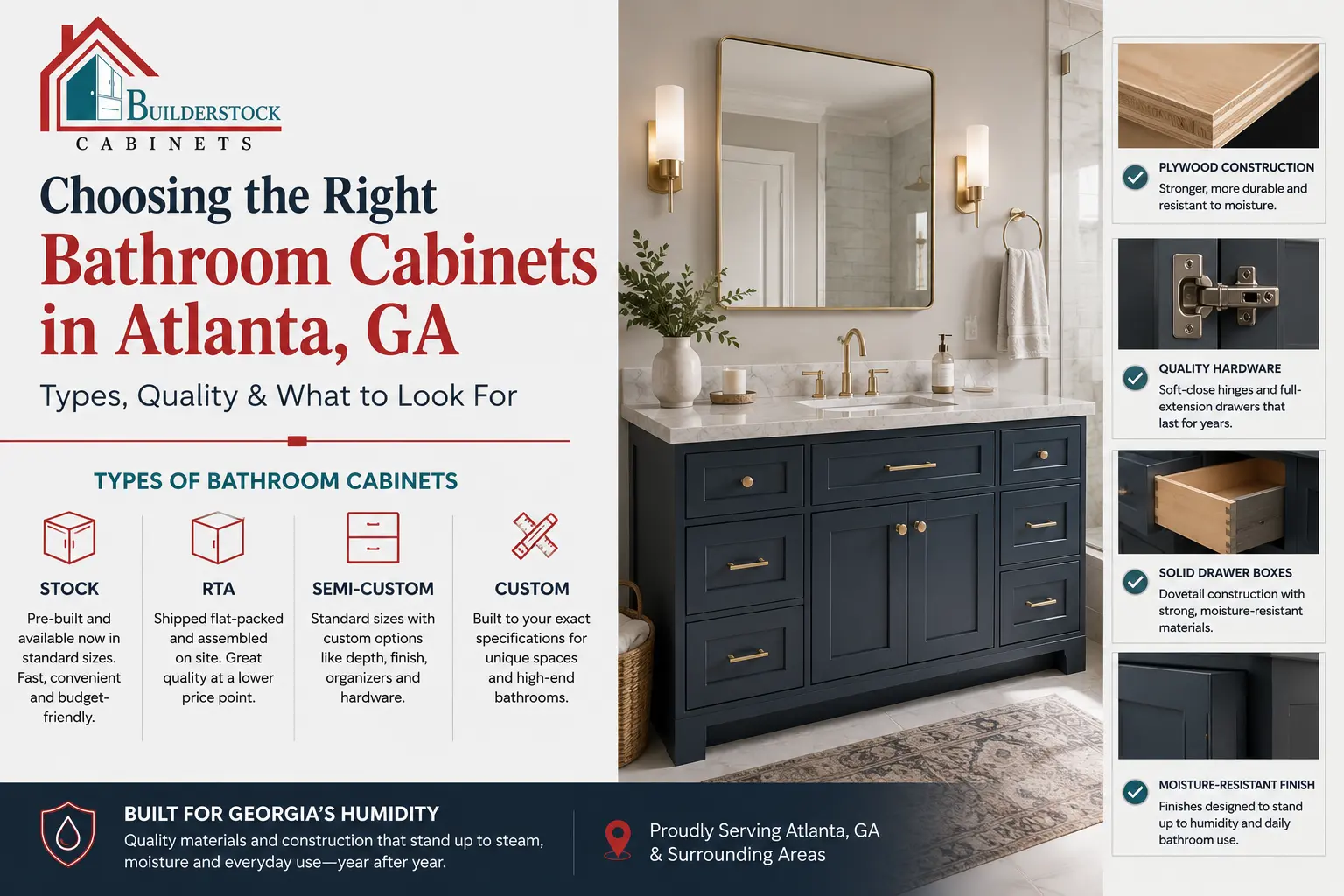
A bathroom is the most moisture-intensive room in the house. Steam, condensation, splashing, and changing temperatures all affect cabinetry in ways that kitchen cabinets simply do not deal with. The cabinets that work in Atlanta bathrooms are the ones built with plywood box construction, quality hardware, and finishes designed to resist humidity long term.
This guide walks through everything you need to know before buying bathroom cabinets in Atlanta: what types exist, how to tell quality from filler, which styles work in Georgia homes, and how to make a decision that holds up for years instead of months.
Types of Bathroom Cabinets Available in Atlanta
There are four main categories of bathroom cabinets available to Atlanta homeowners. Each one fits a different budget and project type.
Stock Bathroom Cabinets
Stock cabinets are pre-built in standard sizes and ready to purchase immediately. They are the fastest option from selection to installation. Standard widths run from 24 to 60 inches, and most are built in 3-inch increments. The trade-off is that you work with what is available in the sizes that exist. For most bathrooms, this is not a problem. Standard bathroom layouts accommodate standard vanity sizes without much adjustment.
Stock cabinets from quality local suppliers like Builder Stock Cabinet are built with the same plywood construction as higher-priced options, just without the custom lead times or markups. For a remodel on a set timeline, this is often the smartest choice.
Ready-to-Assemble (RTA) Cabinets
RTA cabinets ship flat-packed and are assembled on site. They are generally more affordable than fully assembled stock because the shipping cost is lower and the labor for assembly has not been done at the factory. A lot of people assume RTA means lower quality. That is not accurate. The box construction materials and hardware on a quality RTA cabinet can match or beat a fully assembled unit at a similar price point.
RTA cabinets are popular with Atlanta contractors working on investment properties and renovation flips because they offer good material quality at a cost that works for tight project budgets. Assembly adds a few hours per cabinet, but the cost savings often justify it.
Semi-Custom Bathroom Cabinets
Semi-custom cabinets start with standard sizes but allow modifications. You can adjust the depth, add interior organizers, specify the finish color, or choose hardware options that are not available in stock lines. Lead times are longer, typically two to four weeks, and the cost is higher than stock. Semi-custom makes sense when your bathroom has an unusual layout or when you want specific features that standard cabinets do not offer.
Custom Bathroom Cabinets
Custom cabinets are built from scratch to your exact specifications. Size, depth, finish, wood species, interior layout: all of it is specified by you or your designer. Lead times run four to twelve weeks depending on the shop. Custom is the right choice for high-end master bath renovations, unusual architectural spaces, or when matching existing millwork is essential. The price reflects the labor involved. For most Atlanta bathroom renovations, custom is not necessary unless the space genuinely requires it.
What Quality Actually Looks Like in a Bathroom Cabinet
You cannot always tell from a photo whether a cabinet is built well. Here is what to look at when you are evaluating options in person or asking a supplier about construction details.
Box Construction: Plywood vs. Particleboard
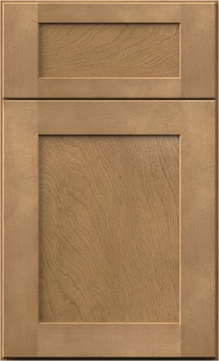
The box is the part of the cabinet that never gets seen once it is installed. It is also the part that matters most in a bathroom. Plywood is made from cross-laminated wood veneers, which gives it stability and resistance to moisture absorption. Particleboard is made from compressed wood particles and adhesive. It is cheaper to manufacture. It also absorbs moisture, swells, and weakens at fastener points over time.
In Atlanta, where bathroom humidity runs high for much of the year, particleboard construction is a liability. When comparing bathroom cabinets, ask specifically: is the box plywood or particleboard? If the answer is particleboard, it is worth paying more for a plywood alternative. The difference over five to ten years of use is significant.
Door and Drawer Construction
Solid wood doors hold finishes better than MDF doors and resist warping. MDF is stable and takes paint well, but it is heavier and less forgiving in high-moisture environments over time. Dovetail joints on drawers indicate quality construction. A dovetail joint interlocks at the corner. It does not rely on staples or glue alone. It handles years of pulling open and closed without the joint loosening.
Hardware Quality
Soft-close hinges and drawer slides are not just a nice feature. They reduce daily wear on the cabinet box by preventing doors and drawers from slamming. Better hardware brands like Blum run smoothly for decades under normal use. Lower-quality hardware starts to drag or fail within a few years. Ask what hardware brand is used before you purchase.
Finish
A quality finish resists moisture and cleaning products without fading or peeling. In bathroom cabinets, finish durability matters more than in kitchen cabinets because of the direct steam and splash exposure. Look for a finish that has been applied in multiple coats and cured properly. Cabinet doors should have a consistent sheen without visible brush marks or thin spots at the edges.
Popular Bathroom Cabinet Styles in Atlanta Homes
Atlanta is a city with a lot of housing variety. Historic bungalows in neighborhoods like Grant Park sit three miles from new construction townhomes in Old Fourth Ward. Master bath renovations in Buckhead look different from powder room updates in Stone Mountain. The right cabinet style depends on the home.
Shaker Style
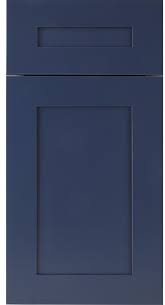
Shaker cabinets are the most common choice in Atlanta bathrooms right now, and they have stayed that way for a decade. The five-piece door with a flat center panel and square frame is clean, simple, and works across architectural styles. It fits in a craftsman bungalow without looking out of place. It works in a new construction home without looking dated. If you are not sure what style to choose, shaker is the safe and genuinely good answer.
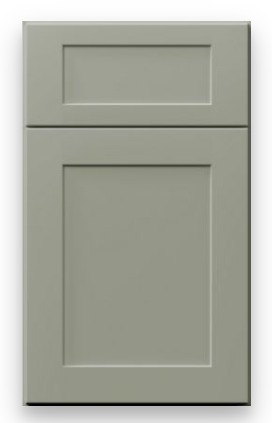
Builder Stock Cabinet offers shaker options in White, Gray, Pearl, and several other finishes. The white shaker in particular works in nearly every Atlanta bathroom context, from traditional to contemporary.
Floating or Wall-Mounted Vanities
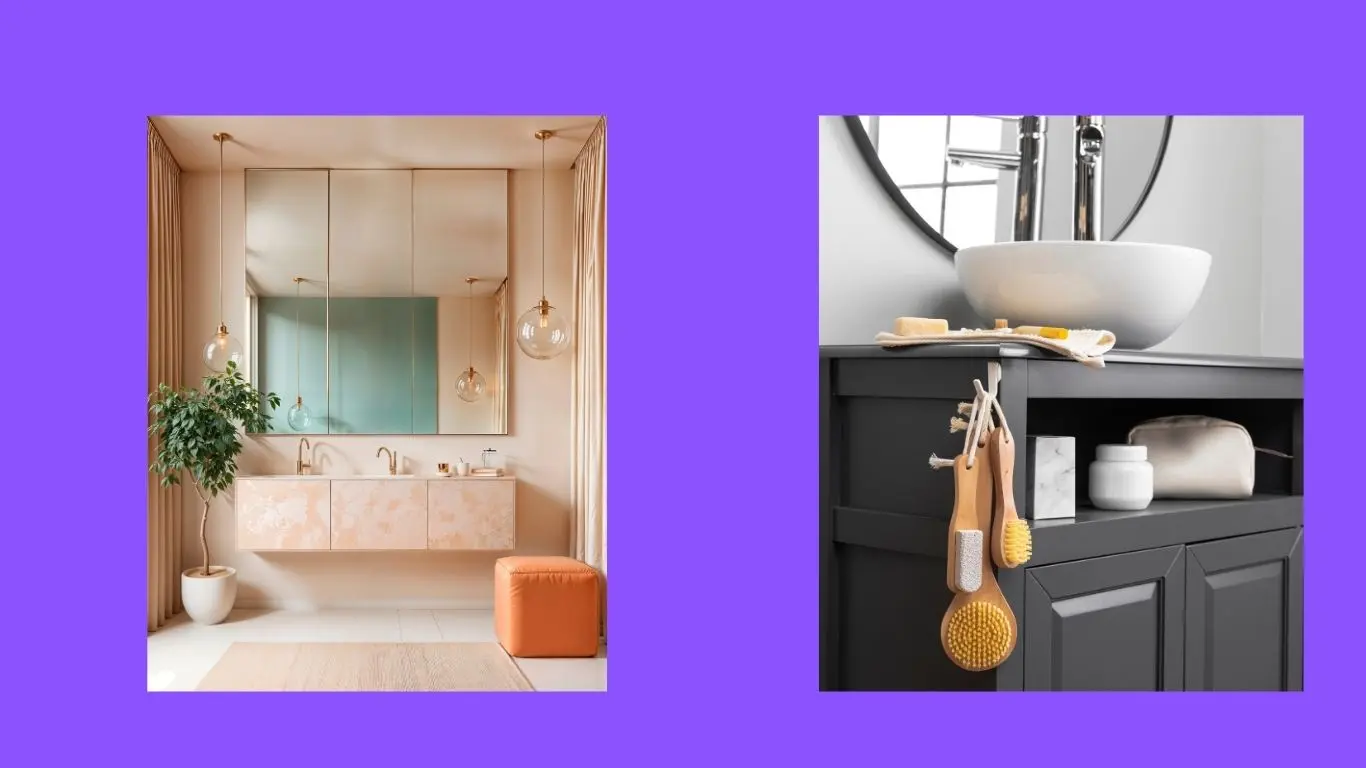
Floating vanities have no legs and attach directly to the wall. The floor below is fully exposed, which makes smaller bathrooms feel more open and makes floor cleaning easier. They work particularly well in Atlanta condos and apartments where bathroom square footage is limited. The installation is slightly more involved than a floor-standing vanity because the cabinet needs to be anchored to wall studs with sufficient support for the weight.
Traditional Raised-Panel Cabinets
Raised-panel doors have more visual weight and a more formal appearance. They work best in homes where the existing architecture already has some traditional character. Virginia-Highland, Druid Hills, and Inman Park homes often have this kind of detailing, and raised-panel vanity cabinets complement that existing style. In a very contemporary home, raised-panel can feel out of place.
Modern Flat-Front Cabinets
Flat-front or slab-front cabinet doors have no detail profile at all. Just a flat panel. This look works well in urban condos, loft conversions, and new construction homes with a minimalist design direction. It is clean, quiet, and works with most hardware styles. Matte black hardware on a white flat-front cabinet has been popular in Atlanta for the past few years.
How to Size Bathroom Cabinets for Your Space
Getting the sizing right before you purchase saves you from returns, installation delays, and the frustration of a cabinet that is slightly wrong in two or three ways at once.
Vanity Width
Measure the width of the existing vanity first. Standard widths are 24, 30, 36, 42, 48, and 60 inches. Check the clearance to nearby walls, the toilet, and the shower door or tub edge. You need enough room for doors to open fully and drawers to extend all the way without hitting anything.
Vanity Depth
Standard vanity depth is 21 to 22 inches. In a small bathroom, a shallower depth (18 inches) can make a real difference for daily movement. Deeper vanities (24 inches) offer more under-sink storage but take up more floor space.
Vanity Height
Standard vanity height is 32 inches without the countertop, which brings the finished height to approximately 34 to 36 inches. Comfort height vanities sit at 36 inches before the countertop, bringing the finished surface to about 36 to 38 inches. Taller households often prefer comfort height. It is worth thinking about who uses the bathroom most before choosing.
Wall Cabinets and Medicine Cabinets
Wall-mounted bathroom cabinets and medicine cabinets follow different sizing logic. They need to clear the mirror height (typically 5 to 6 inches above the vanity countertop) and stay below the ceiling by a few inches for a clean look. Depth on wall cabinets is usually 4 to 6 inches. Deep enough to store toiletries. Shallow enough not to feel like they are taking over the room.
Local Suppliers vs. Big-Box Stores: What Is Actually Different
This question comes up constantly in Atlanta renovation circles. The answer depends on what matters most to you in the purchase.
Inventory and Lead Time
Big-box stores like Home Depot and Lowe's carry a limited range of bathroom vanity options in-store. If what you see on the shelf fits your project, you can take it home that day. If you want something specific, you are often ordering and waiting two to four weeks for delivery. A local supplier like Builder Stock Cabinet carries a focused inventory of quality options and can often get product to you faster because they are not routing through a national distribution network.
Local Knowledge
A local supplier understands Atlanta's housing stock in a way that a national retailer does not. They know what dimensions fit the bathrooms built in Cobb County in the 1980s versus new construction in Forsyth County today. They know what finishes hold up in Georgia's humidity and which styles work in which neighborhoods. That knowledge matters when you are making a purchase that will be in your home for the next ten years.
Pricing
Big-box stores have scale on their side. For basic commodity cabinets, they can compete on price. Where local suppliers win is in the middle range, where you want quality materials and construction without custom-shop pricing. Builder Stock Cabinet's pricing sits in that range: better construction than big-box alternatives, without the premium of a custom shop or designer showroom.
Support and Design Help
A local supplier can do things a big-box store cannot. Builder Stock Cabinet offers a free AI-assisted design tool to help you visualize options before committing. They can schedule video consultations, provide door samples, and answer project-specific questions. When the people you are talking to also know the Atlanta market, the conversation is more useful than a product chat with a national call center.
Bathroom Cabinet Costs in Atlanta (2026 Breakdown)
Bathroom cabinet pricing in Atlanta varies widely depending on cabinet type, material, and where you buy. Here is a realistic breakdown for 2026:
| Cabinet Type | Typical Cost Range | Best For |
|---|---|---|
| Stock vanity cabinets (RTA) | $200 - $800 | Budget-conscious remodels, rentals, flips |
| Stock assembled vanity | $400 - $1,500 | Primary bathrooms, mid-range remodels |
| Semi-custom vanity | $800 - $2,500 | Unusual layouts, specific finish requirements |
| Custom vanity | $2,000 - $8,000+ | High-end master baths, unique architectural spaces |
| Wall and medicine cabinets | $150 - $600 | Added storage in any bathroom |
These figures are for the cabinet itself and do not include countertop, sink, faucet, or installation labor. A full bathroom cabinet and vanity project in Atlanta, when you add those components, typically runs $800 to $3,500 for a single bathroom depending on the choices made.
One way to control cost without sacrificing quality is to use stock or RTA cabinets from a supplier who builds them with the same plywood construction as higher-priced alternatives. The affordable bathroom cabinet options at Builder Stock Cabinet reflect that approach: quality construction at pricing that fits most Atlanta renovation budgets.
Six Questions to Ask Before You Buy Bathroom Cabinets in Atlanta
These questions are worth asking any supplier before you commit to a purchase.
1. Is the box plywood or particleboard? This is the single most important construction question in a bathroom context. If the answer is particleboard, keep looking.
2. What hardware brand is used? Quality hardware (hinges, drawer slides) makes a difference in long-term performance. Ask for the brand name and look it up if you are not familiar with it.
3. How long is the lead time? If you have a contractor scheduled, you need cabinets on-site before they arrive. Confirm the availability and delivery timeline before booking any installation.
4. What does the warranty cover? Cabinet warranties vary. Some cover only the box construction, others include hardware. Ask what is covered and for how long.
5. Can I see a sample door? Finish colors look different on screens than they do in person under your bathroom's lighting. Request a physical door sample before making a final color decision.
6. Does the supplier have experience with Atlanta homes? Local market knowledge matters. A supplier who understands Atlanta's housing stock and climate conditions can give you better guidance than a national retailer's phone support team.
Builder Stock Cabinet's FAQ page addresses many of these questions directly, and their team is available by phone, text, and email for project-specific questions before you buy.
FAQs:
What type of bathroom cabinet holds up best in Atlanta's climate?
Plywood box construction with a quality multi-coat finish. Georgia's humidity is hard on particleboard over time. Plywood handles moisture cycling much better and stays structurally sound longer. This is the most important construction variable to check when comparing options.
What is the difference between RTA and assembled bathroom cabinets?
Ready-to-assemble (RTA) cabinets ship flat and are assembled on site. Fully assembled cabinets arrive ready to install. The core construction quality can be identical between the two. RTA costs less because of lower shipping weight and no factory assembly labor. Both work well for bathroom vanities when the box material and hardware are quality.
What bathroom cabinet styles are most popular in Atlanta in 2026?
Shaker-style in white or gray remains the most consistent choice across Atlanta homes and renovation projects. Floating vanities are growing in popularity, particularly in condos and smaller bathrooms. Modern flat-front styles are common in loft renovations and new construction. Traditional raised-panel works best in historic homes where it matches the existing architecture.
How long does it take to get bathroom cabinets from a local Atlanta supplier?
Stock and RTA cabinets from a local supplier like Builder Stock Cabinet are often available immediately or within a few days. Semi-custom options typically take two to four weeks. Custom cabinets can take six to twelve weeks depending on the shop and the complexity of the order.
Can bathroom cabinets increase my Atlanta home's value?
Updated bathroom cabinets are one of the mid-range upgrades that reliably contribute to resale value. Real estate professionals in Atlanta consistently report that updated bathrooms help homes sell faster and at better prices, particularly in competitive neighborhoods like Sandy Springs, Decatur, and Smyrna. The return depends on what you spend and what comparable homes have already done.
Is it worth buying bathroom cabinets from a local supplier vs. online?
For most Atlanta homeowners, yes. Local suppliers offer product samples, faster delivery, and knowledge of the local market. You can see and touch what you are buying. Returns and exchanges are simpler. And when something goes wrong with an order, you are dealing with a local business that cares about its reputation rather than a distant fulfillment center.
Find the Right Cabinets for Your Atlanta Bathroom
If you are planning a bathroom renovation in Atlanta and want cabinets that will actually hold up in Georgia's climate, start with the right supplier.
Builder Stock Cabinet in Stone Mountain serves homeowners, contractors, and property investors across the Atlanta metro area, including Buckhead, Marietta, Decatur, Sandy Springs, Roswell, Alpharetta, Johns Creek, and Kennesaw. Their cabinet collections use plywood box construction, quality hardware, and finishes designed for the Georgia climate.
They offer a free AI design tool to help you visualize options before you buy, and their team can walk you through sizing, style selection, and material comparisons before you commit to anything.
Showroom location: 1707 Stoneridge Dr, Suite B, Stone Mountain, GA 30083
Phone and text: +1 678-515-9921
Email: info@builderstockcabinet.com
Hours: Monday through Saturday, 8:00 AM to 5:00 PM
Contact Builder Stock Cabinet to request a free quote, order door samples, or schedule a video consultation with their design team. Bring your measurements and they will help you find the right fit for your space and budget.
Also worth reading: The Ultimate Guide to Kitchen Cabinets in Atlanta if you are also considering a kitchen cabinet update as part of your remodel.
External resources:
NKBA 2024 Design Trends Study - industry research on bathroom design and cabinet trends.
EPA Indoor Air Quality - guidance on moisture management and ventilation in bathrooms.