




You've looked at kitchen cabinet options for weeks, maybe longer. You've compared custom, semi-custom, and stock. You've watched videos, read design blogs, and probably walked through at least one big-box store just to see what's out there. And you've landed on stock cabinets.
That's a sound decision for most Atlanta homeowners. Stock cabinets offer faster lead times, predictable pricing, and wide availability in the styles and finishes that work in most kitchens. The gap in quality between stock and semi-custom has narrowed significantly over the past decade, particularly from suppliers who focus on cabinetry rather than treating it as a secondary product line.
This guide is for buyers who are past the "should I buy stock cabinets" question. You're ready to order. What you need now is practical information that helps you buy the right product, avoid the common pitfalls, and understand what separates a quality kitchen cabinet in Atlanta from one that's going to cause problems in two years.
What Stock Cabinets Actually Are (and Aren't)
Stock cabinets are manufactured in standard sizes and kept in inventory, ready to ship. They come in fixed width increments, typically 3-inch steps from 9 inches to 48 inches wide, and in standard heights of 30, 36, and 42 inches for wall cabinets, and 34.5 inches for base cabinets to accommodate a standard countertop height.
The word "stock" sometimes gets treated like a negative, as if stock cabinets are automatically lower quality than custom. That's not accurate. Quality depends on what goes into the cabinet construction, not whether it was built to order.
What stock cabinets don't offer is size flexibility. If your kitchen has an unusual configuration that needs a 17-inch wide cabinet or a 37-inch tall upper, a stock line won't accommodate that without filler strips or creative solutions. Most standard kitchen layouts, however, work fine with stock sizing.
Stock cabinets are also distinct from ready-to-assemble (RTA) cabinets, though the terms are sometimes used interchangeably. The difference is whether the cabinet arrives assembled or in flat-pack form. Both fall under the broader stock cabinet category.
What Separates Good Stock Cabinets from Cheap Ones
This is the most important section for buyers who are comparing options across multiple suppliers in Atlanta. Two cabinets that look identical in a photo can be dramatically different in actual quality.
Box construction: plywood vs particleboard
The box is the cabinet carcass: the sides, top, bottom, and back. Plywood box construction is the standard you want. Plywood handles Atlanta's humidity better than particleboard, resists warping, and holds screws more reliably over time. This matters most near sinks and dishwashers where moisture is a factor. Particleboard is cheaper to manufacture and is common in lower-cost cabinet lines. It's not automatically a dealbreaker, but it's something to ask about directly before purchasing.
Drawer box construction
Drawer boxes take more abuse than almost any other part of a cabinet. Look for dovetail drawer box joints, which interlock rather than relying on glue or staples alone. Undermount soft-close drawer slides are the current standard for mid-range and above quality. They close silently and last longer than side-mount slides.
Door hinges
Six-way adjustable concealed hinges are the right choice. They allow you to adjust door alignment after installation without removing the door. Soft-close is worth the minor upcharge. Hinges are something you'll interact with thousands of times over the life of the kitchen.
Finish quality
For painted cabinets, look for a multi-step finish process: primer coat, sanding, topcoat at minimum. Cabinet doors that are sprayed in a controlled factory environment hold up better than those with a brush-applied finish. For wood species cabinets, a catalyzed varnish or conversion varnish resists moisture and cleaning chemicals better than standard lacquer.
Face frame vs frameless construction
Face frame cabinets have a wooden frame attached to the front of the box. They're the traditional American cabinet construction and are common in stock cabinet lines. Frameless (European-style) cabinets have no face frame and provide more interior access. Both are available in stock options. The choice usually comes down to the door style and aesthetic you're going for.
How to Size Your Kitchen for Stock Cabinets
Measuring for stock cabinets is one area where buyers consistently underestimate the detail required. A few mistakes here become very expensive once you've placed the order.

Measure twice, order once
Measure all wall lengths from inside corner to inside corner. Measure at counter height and at ceiling height separately, because walls are not always perfectly plumb. Note any windows, doors, appliance locations, and the position of electrical outlets and plumbing rough-ins.
Account for filler strips
When your wall measurement doesn't land on a standard cabinet width increment, you fill the gap with a filler strip. Filler strips are standard practice and not a sign of poor planning. Plan them in advance rather than ordering them after the fact.
Know your appliance dimensions
Standard refrigerator openings, range openings, and dishwasher rough-ins need to match your appliances. If you're replacing appliances as part of the remodel, confirm the new appliance dimensions before ordering cabinets. A refrigerator that's two inches wider than your cabinet opening is a serious problem.
Ceiling height determines upper cabinet height
Standard 8-foot ceilings work well with 30-inch wall cabinets and 12 to 18 inches of clearance above the countertop. If you have 9 or 10-foot ceilings, 36 or 42-inch wall cabinets are options. The space above wall cabinets can be handled with crown molding or left open depending on the design.
If you're not confident in your own measurements, Builder Stock Cabinets offers layout assistance. Providing your measurements to a cabinet specialist before ordering is the single most effective way to avoid ordering errors. Get in touch to review your layout before you commit.
Popular Stock Cabinet Styles in Atlanta Right Now
Atlanta's kitchen design market has a clear direction right now, with a few dominant styles across different price points and neighborhood types.
White shaker
Still the most purchased stock cabinet configuration in Atlanta. White shaker with quartz countertops reads well in listing photos, appeals to a wide buyer demographic, and works in both traditional and contemporary kitchen layouts. It's not exciting, but it's reliable and resale-friendly.
Gray shaker
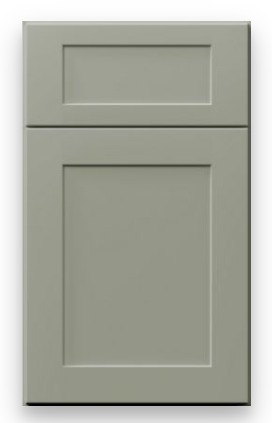
Medium gray has held its position in Atlanta kitchens for several years now. Warm grays with beige undertones are currently more popular than cool blue-grays, which feel slightly dated. Gray lower cabinets paired with white uppers is a common two-tone configuration that performs well across the market.
Natural wood tones
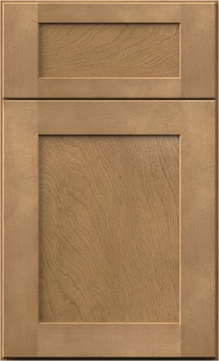
There's been a meaningful move back toward natural wood finishes in Atlanta kitchens. Light oak, warm maple, and walnut-look finishes on shaker doors are being specified in new construction and high-end remodels. This trend works particularly well in open-concept homes where the kitchen connects to living areas with similar wood tones.
Navy blue and deep green
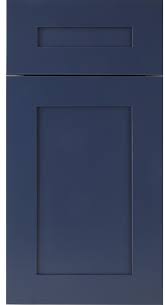
Color has been gradually coming back to Atlanta kitchens after a decade of neutrals. Navy blue lower cabinets with white uppers are the most common color accent configuration. Deep forest green on a kitchen island is gaining traction in transitional and farmhouse-style kitchens across the metro area.
Browse the kitchen cabinet collections at Builder Stock Cabinets to see current stock inventory in these finishes for Atlanta delivery.
Why Atlanta Homeowners Are Choosing RTA Cabinets
Ready-to-assemble cabinets ship flat-packed and are assembled on-site. They cost less to ship because the boxes are smaller, and they can sometimes be stocked in larger quantities than pre-assembled cabinets.
The quality of RTA cabinets varies widely. At the top end of the RTA market, you get plywood box construction, dovetail drawer joints, and soft-close hardware. At the low end, you get particleboard with staple-and-glue joints. The RTA format tells you nothing about the quality inside.
RTA cabinets are a practical choice for Atlanta homeowners who are managing their own installation or working with a contractor who has assembly experience. The assembly process for a full kitchen takes time but is within reach for someone comfortable with basic carpentry tools.
For homeowners who want cabinets delivered ready to hang without assembly, pre-assembled stock cabinets are available at a modest price premium. Builder Stock Cabinets carries both options in the same quality lines, so you can choose based on your installation situation rather than sacrificing quality either way.
Don't Forget Bathroom Vanities
Kitchen cabinet buyers often have bathroom remodels on their list too, and sourcing vanities through the same supplier as your kitchen cabinets makes sense for budget, scheduling, and finish consistency.
Bathroom vanities in the Atlanta market follow the same style trends as kitchens: white and gray remain the most popular painted finishes, with natural wood tones gaining ground in primary bathrooms. Floating vanities (wall-mounted, with no floor contact) are popular in contemporary primary bathrooms and en-suite spaces.
Vanity sizing follows different logic than kitchen cabinets. Single vanities range from 24 inches to 48 inches wide. Double vanities run from 60 to 72 inches. Sink configuration (undermount, vessel, or integrated) affects which cabinet lines are appropriate. Vanities at Builder Stock Cabinets are available in the same quality construction as the kitchen cabinet lines, so you're not trading down when you add a bathroom project to your order.
Five Mistakes Atlanta Buyers Make When Ordering Stock Cabinets
These are the errors that show up consistently. Knowing them in advance is worth more than any discount.
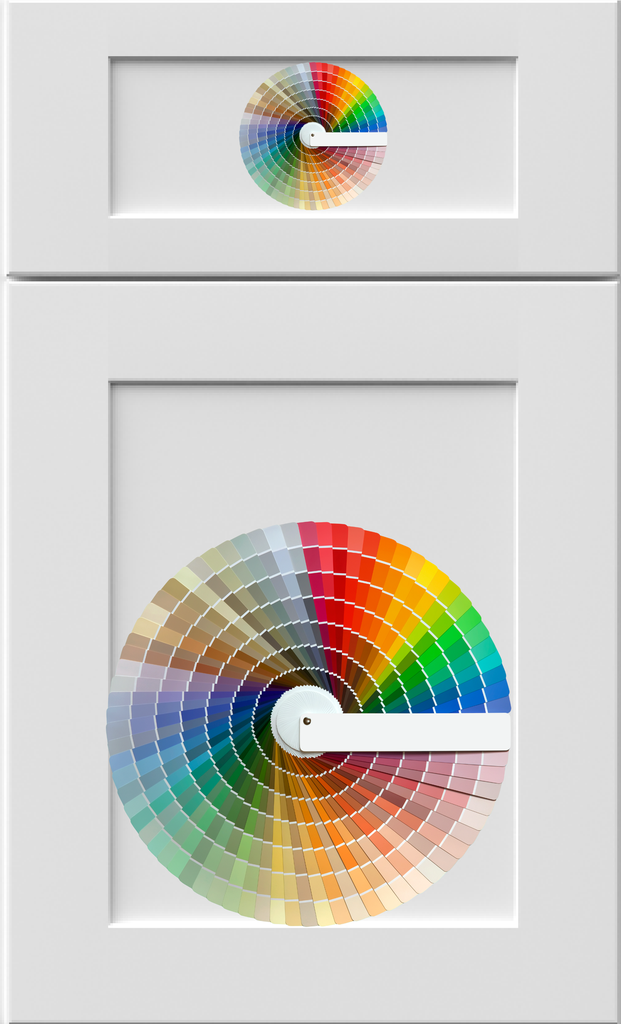
- Not ordering samples before committing. Cabinet finishes look different on a screen than they do in person. What reads as "warm white" in a product photo may look slightly yellow or cream under your kitchen's actual lighting. Order door samples in your top two or three finish choices before placing the full order. Builder Stock Cabinets also has an in-person showroom where you can evaluate finishes under real lighting conditions.
- Forgetting to order extra. Cabinet doors get damaged during installation. Ordering one or two extra doors in your configuration protects you from a future where you need a replacement door and the finish has been discontinued. This is especially relevant for painted finishes.
- Underestimating filler and trim needs. Crown molding, light rail, filler strips, and toe kick material need to be ordered as part of your initial order. Running out mid-installation slows down your project and can create finish inconsistencies if the lot differs.
- Not confirming lead times before scheduling trades. Stock cabinets typically ship faster than custom, but "in stock" doesn't always mean "available tomorrow." Countertop templates are cut after cabinets are installed, so a delayed cabinet delivery cascades into a delayed countertop delivery.
- Buying on price alone. The cheapest stock cabinet option in Atlanta is rarely the best one. A $3,000 difference in cabinet cost can translate into a $15,000 difference in kitchen quality and longevity if you're choosing between particleboard and plywood construction. Know what you're buying before you buy it.
Why Builder Stock Cabinets for Your Atlanta Kitchen
Builder Stock Cabinets is a dedicated cabinet supplier serving Atlanta and the surrounding Georgia communities, including Marietta, Decatur, Sandy Springs, Roswell, Alpharetta, Johns Creek, Woodstock, and Kennesaw.
The difference between a dedicated cabinet supplier and a big-box home improvement store comes down to product depth and expertise. At a national chain, cabinets are one of hundreds of product categories. At a specialized supplier, the entire business is cabinets, and the people you talk to know the product specifications well enough to answer detailed construction questions.
Builder Stock Cabinets carries quality-built stock and RTA cabinets in the styles and finishes that move in the Atlanta market, without marking up for brand names that don't add construction value. That's a meaningful distinction when you're spending $8,000 to $20,000 on a kitchen. The showroom is set up so you can compare door styles, finishes, and hardware combinations in person rather than making a major purchase decision based on a product page.
Conclusion
Buying stock cabinets for your Atlanta kitchen is a good decision when you buy the right product from the right supplier. The key is knowing what to look for: plywood box construction, dovetail drawer joints, soft-close hardware, and a finish that will hold up to daily use. Sizing accurately, ordering extras, and confirming lead times before scheduling contractors will save you from the problems that slow down most kitchen remodels. And seeing your finish selection in person, rather than relying on a product photo, is the single most effective step you can take before placing a large order.
Ready to Order? Talk to Builder Stock Cabinets.
Builder Stock Cabinets works with Atlanta homeowners, remodelers, and contractors who are ready to move forward with a kitchen cabinet purchase. Whether you're renovating in Decatur, building new in Alpharetta, or handling a multi-unit project in the metro area, the team can help you select the right cabinets, confirm sizing, and get your order moving.
Browse the available stock and RTA cabinet collections, or get in touch with Builder Stock Cabinets to review your layout and get your kitchen moving.
FAQs:
How long does it take to receive stock cabinets in Atlanta?
Lead times vary by supplier and current inventory levels. In-stock items from local suppliers like Builder Stock Cabinets can often be ready for pickup or delivery within a few days to two weeks. Items that need to be sourced or are temporarily out of stock may take longer. Confirm lead time at the time of order and before scheduling your installer.
Are stock cabinets good enough for a high-end Atlanta kitchen remodel?
Yes, in most cases. The quality ceiling on stock cabinets has risen considerably. Plywood box construction, soft-close hardware, and multi-step painted finishes are available in stock cabinet lines and are the same features found in higher-priced semi-custom products. The main limitation is size flexibility, not construction quality.
Can I install stock cabinets myself in Atlanta?
Experienced DIYers with basic carpentry skills can install stock cabinets. The process requires careful measuring, leveling, and some comfort with power tools. RTA cabinets add an assembly step before installation. Many Atlanta homeowners choose professional installation to protect their investment and avoid errors, particularly in kitchens with complex layouts.
What is the difference between stock cabinets and RTA cabinets?
Stock cabinets are manufactured in standard sizes and available for purchase from inventory. RTA (ready-to-assemble) cabinets are a subset of stock cabinets that ship flat-packed and are assembled on-site. The quality of an RTA cabinet depends on its construction materials, not the fact that it requires assembly.
Does Builder Stock Cabinets serve areas outside Atlanta proper?
Yes. Builder Stock Cabinets serves homeowners, contractors, and builders throughout the Atlanta metro area, including Marietta, Decatur, Sandy Springs, Roswell, Alpharetta, Johns Creek, Woodstock, Kennesaw, and surrounding communities.