






Table of Contents
- What Are RTA Cabinets?
- What Are Custom Cabinets?
- The Cost Difference in Atlanta
- Quality: What the Price Gap Actually Means
- Timeline and Lead Times
- Installation Differences
- Odd-Sized and Non-Standard Kitchens
- Which Option Fits Which Homeowner
- Semi-Custom: The Middle Ground
- FAQs: Kitchen Cabinets in Atlanta
- Making the Right Call for Your Atlanta Kitchen
What Are RTA Cabinets?
RTA stands for ready to assemble. The cabinet boxes, doors, and hardware are shipped flat-packed and assembled on-site, either by a contractor or by the homeowner. The cabinet components are pre-cut and pre-drilled. Assembly typically involves connecting the box sides, attaching the back panel, mounting the doors, and installing the drawer slides.
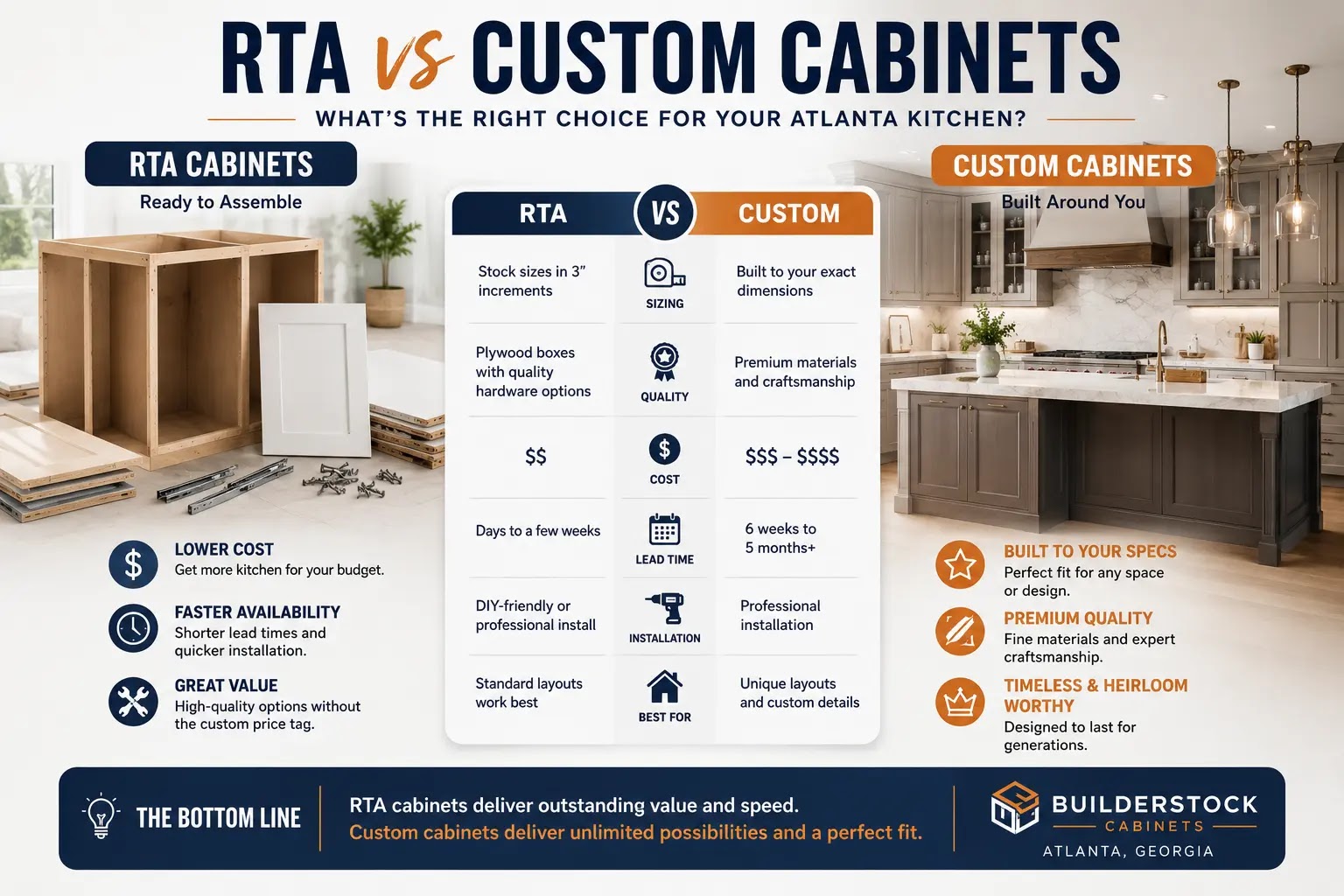
RTA cabinets are sold in standard sizes, typically in 3-inch width increments, and come in a range of styles, finishes, and box depths. For most kitchen layouts in Atlanta, the standard size options cover the space without any major fitting problems. Filler panels handle gaps where standard cabinet widths don't reach a wall precisely.
RTA is not a quality designation. It's a delivery and assembly format. Some RTA cabinets are low-quality imported products. Others are solid plywood construction with dovetail drawer boxes and soft-close hardware. The quality depends entirely on the manufacturer and the line you're buying, not on the RTA label.
What Are Custom Cabinets?
Custom cabinets are built to order from scratch, sized to your exact kitchen dimensions and specifications. A cabinetmaker measures your space, designs the layout, builds each cabinet to those measurements, and installs the finished product.
This process gives you complete control over dimensions, wood species, door profiles, finishes, interior fittings, and any unusual configuration your kitchen requires. If your kitchen has an angled wall, a ceiling that drops on one side, or a layout that standard sizes simply can't accommodate, custom is the path that solves it cleanly.
Full custom cabinetry is made by local Atlanta cabinet shops, regional manufacturers, and high-end national brands. Lead times run from six weeks on the shorter end to four or five months for fully custom work. The build happens in a shop before anything enters your kitchen, so mistakes discovered late can cause delays.
The Cost Difference in Atlanta
Cost is where the RTA versus custom conversation gets practical fast.
RTA kitchen cabinets for a mid-sized Atlanta kitchen, in the range of 10 to 15 linear feet of cabinetry, typically run significantly lower than semi-custom or full custom options. Stock and RTA cabinets from a local Atlanta supplier let you see the product before buying and often have faster availability than cabinets ordered through a big-box national chain.
Custom cabinets for the same kitchen are often two to four times the price of quality RTA cabinets, sometimes more depending on the wood species, finish, and the shop doing the work. The higher cost reflects labor: the design time, the build time, the installation time, and the expertise required to do all of it well.
Semi-custom cabinets land in between. You work with a standard size range but can adjust some dimensions and specify finishes. The price is typically 30 to 60 percent above comparable stock options.
For homeowners working within a defined renovation budget, the cost difference between RTA and custom isn't abstract. It often translates into a choice between a full kitchen renovation with quality RTA cabinets now, or waiting considerably longer to afford the custom option.
Quality: What the Price Gap Actually Means
There's a common assumption that custom automatically means better quality. It's worth pushing back on that a little.
Where custom cabinets have a genuine advantage
Custom cabinets done by a skilled local Atlanta cabinetmaker can be built to a level of quality that no stock product matches. Solid wood throughout, traditional joinery, hardware chosen for longevity rather than cost. A well-built custom cabinet can outlast the house. That's real, and it's worth paying for if you plan to stay in the home long-term and want something that's genuinely heirloom-level.
Where RTA quality has closed the gap
Mid-range and upper-tier RTA cabinet lines now offer plywood box construction, dovetail drawer joints, full-extension soft-close drawer glides, and solid wood door fronts. These are not low-quality products. They're manufactured at scale in a controlled environment, which actually reduces some of the variation you can get from custom shop work.
The meaningful quality differences in the RTA market come down to box material (plywood versus particle board), drawer construction (dovetail versus stapled), and hardware quality. A quality RTA cabinet line from a reputable supplier performs well in Atlanta kitchens for 15 to 20 years with normal use.
What doesn't actually affect daily performance
Whether the cabinet was custom-built or assembled on-site doesn't change how well a drawer opens, how the door closes, or how the finish wears. The hardware and build quality of the box and door fronts determine that. An expensive custom cabinet with low-quality undermount drawer slides will frustrate you more than a well-built RTA cabinet with quality hardware.
Timeline and Lead Times
For Atlanta homeowners with a set move-in date or a kitchen renovation that needs to finish by a specific time, lead times matter considerably.
RTA and stock cabinets from a local Atlanta supplier can often be available within days or a few weeks. If you're working with a contractor who has a crew ready, the kitchen can be ordered, delivered, assembled, and installed in a realistic timeframe.
Custom cabinets typically require four to sixteen weeks from order to delivery, depending on the shop and how busy they are. During Atlanta's busier remodeling seasons, spring and fall, lead times stretch. If your renovation hits a delay and your cabinets are halfway through production, you're waiting on them regardless.
For a rental property flip, a kitchen refresh before listing a home for sale, or a renovation with a defined move-in date, the faster availability of RTA and stock cabinets is a concrete advantage beyond just price.
Installation Differences
Custom cabinets are installed by the cabinetmaker or by an installer familiar with the product. The installation is part of the project cost and the measurement, build, and install are coordinated by one company.
RTA cabinets can be installed by a contractor, a finish carpenter, or by a handy homeowner with the right tools and time. Assembly adds a step that isn't present with pre-built cabinets, but it's not technically difficult for someone experienced with cabinet work.
For Atlanta homeowners hiring a contractor, the contractor typically handles RTA assembly as part of the installation scope. Labor cost for RTA installation is broadly similar to installing pre-built stock cabinets. The work involved is comparable.
Odd-Sized and Non-Standard Kitchens
Standard RTA cabinet sizes work in most Atlanta kitchens. There are common situations, though, where standard sizes create a challenge.
Where RTA works fine with planning
Most kitchens can be laid out using standard 3-inch increment widths with filler strips covering gaps. A good cabinet layout design, done before ordering, accounts for these transitions. Most Atlanta cabinet suppliers will help you plan the layout to avoid gaps that look unfinished.
Where custom makes more sense
Older Atlanta homes, particularly bungalows and craftsmans in Decatur, Avondale Estates, or in-town neighborhoods, can have unusual dimensions: walls that aren't square, soffits that drop at odd heights, or kitchens that were clearly added or modified over decades. Custom cabinetry handles these situations better than standard sizes.
Very tall ceilings, common in some Atlanta historic homes, also favor custom. Running cabinets to an 11 or 12-foot ceiling with standard 42-inch upper cabinets and stacked crown molding is doable, but getting it to look truly seamless often requires custom sizing at the top.
Which Option Fits Which Homeowner
Neither option is objectively better. They suit different situations.
RTA and stock cabinets in Atlanta make the most sense for homeowners who have a renovation budget with defined limits, need the kitchen done within a set timeframe, have a standard or close-to-standard kitchen layout, or are updating a rental property or flipping a home for resale.
Custom cabinets make more sense for homeowners who are building a forever home and want to invest in quality that lasts decades, have a kitchen with dimensions or configurations that standard sizes genuinely can't handle well, or have a specific vision for wood species, finish, or design detail that requires custom work to achieve.
A lot of Atlanta homeowners fall somewhere in between. Quality semi-custom cabinets or upper-tier RTA lines from a reputable local supplier often deliver what they need at a price that doesn't require refinancing the house.
Semi-Custom: The Middle Ground
Semi-custom cabinets let you modify width, height, and some finish options within a structured range. You're working with a manufacturer's existing framework but adjusting it to fit your kitchen better than pure stock sizes would.
For kitchens where one or two dimensions don't land on a standard size, semi-custom fills the gap without the full cost of custom work. The lead time is longer than stock but typically shorter than full custom. A local Atlanta cabinet supplier can walk you through which dimensions are adjustable and which aren't in any given semi-custom line.
FAQs: Kitchen Cabinets in Atlanta
Are RTA cabinets good quality?
Quality varies widely in the RTA market. Good RTA cabinet lines use plywood box construction, dovetail drawer joints, and quality soft-close hardware. These hold up well in Atlanta kitchens for many years. Lower-end RTA options use particle board and stapled drawer boxes, which wear faster. Buying from a reputable Atlanta supplier and checking the construction specifications before ordering makes a significant difference.
How much cheaper are RTA cabinets compared to custom in Atlanta?
For a typical Atlanta kitchen, quality RTA cabinets typically run significantly lower than full custom cabinetry, often at a fraction of the cost. The exact gap depends on the custom shop's rates and the RTA line you're comparing. Getting quotes on both lets you see the actual difference for your specific project.
Can I install RTA cabinets myself in Atlanta?
Yes, with the right tools and some carpentry experience. RTA assembly is straightforward for most homeowners comfortable with basic woodworking. Professional installation is recommended for larger kitchens, unlevel floors, or situations where precise fitting matters. Many Atlanta contractors include RTA assembly in their cabinet installation pricing.
Do custom cabinets increase home value more than RTA cabinets in Atlanta?
Buyers and appraisers typically don't distinguish between cabinet types during a sale. What matters most is whether the kitchen looks updated, functions well, and is in good condition. Quality RTA kitchen cabinets in Atlanta can provide strong return on investment in resale without the premium cost of custom cabinetry.
How long do RTA cabinets last?
Quality RTA cabinets with plywood construction and solid hardware last 15 to 20 years or more with normal household use. Lower-end options with particle board construction typically wear out faster, particularly near moisture sources. Proper installation and adequate ventilation extend the lifespan in Atlanta's humid climate.
What questions should I ask a cabinet supplier before ordering?
Ask about box material (plywood versus particle board), drawer construction (dovetail versus stapled), hardware brand and type, warranty terms, lead time, and whether they offer layout assistance. A good Atlanta cabinet supplier should answer all of these clearly before you place an order.
Making the Right Call for Your Atlanta Kitchen
The RTA versus custom cabinet decision comes down to your budget, your timeline, your kitchen's dimensions, and how long you plan to stay in the home. Neither option is universally better. Both can produce a kitchen that looks good and functions well for years.
For most Atlanta homeowners working within a real-world budget, quality RTA or stock cabinets from a local supplier offer the clearest path to a kitchen that looks like it cost a lot more than it did. Spend the savings on countertops, appliances, or finishes where the visible impact is high.
If you have an unusual kitchen layout, want full control over materials and design, and are building a home you plan to stay in for decades, custom cabinets are worth the investment. Just go in with realistic timeline expectations and get multiple quotes.
Explore Your Kitchen Cabinet Options in Atlanta
Builder Stock Cabinets offers a range of RTA kitchen cabinets and stock kitchen cabinets for Atlanta homeowners, remodelers, and contractors. From Shaker styles to bathroom vanities, the showroom carries options across multiple price points with staff who can help you plan your layout before you order.
Serving Atlanta and surrounding areas including Buckhead, Marietta, Decatur, Sandy Springs, Roswell, Alpharetta, and Johns Creek. Stop by the showroom or contact a cabinet specialist to talk through your project.